FULL OUTER JOIN
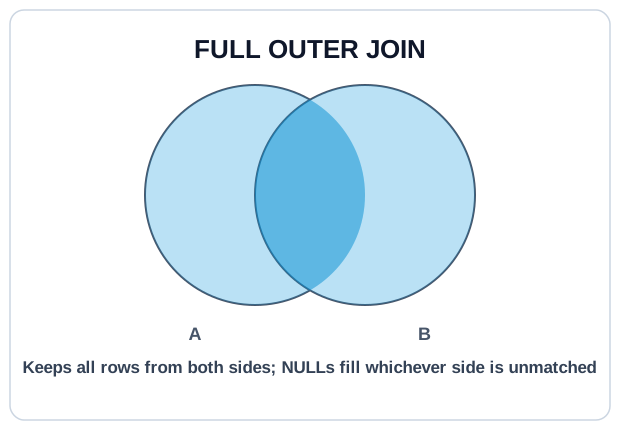
FULL OUTER JOIN keeps every row from both tables.
Where there's a match on the join key, columns from both sides come through. Where there isn't, the missing side is filled with NULL. It's the join for reconciliation: "what's in A but not B, and what's in B but not A, in one query".
Syntax #
SELECT
  COALESCE(u.id, o.user_id) AS user_id,
  u.email,
  o.id AS order_id
FROM users AS u
FULL OUTER JOIN orders AS o
  ON o.user_id = u.id;
Some dialects accept FULL JOIN as shorthand for FULL OUTER JOIN; they're the same operator.
The Reconciliation Pattern #
Use FULL OUTER JOIN when you want to spot differences between two sources of truth:
- Users who have never placed an order and orders whose
user_iddoesn't match any user. - Orders in the warehouse that are missing from the billing system and the reverse.
- Expected dataset vs actual dataset, to find both drops and additions.
Filter for IS NULL on either side to isolate the orphans.
-- Orphans on either side: unmatched users OR unmatched orders
SELECT
  u.id AS user_id,
  u.email,
  o.id AS order_id,
  o.user_id AS order_user_id
FROM users AS u
FULL OUTER JOIN orders AS o
  ON o.user_id = u.id
WHERE u.id IS NULL   -- order with no matching user
OR o.id IS NULL; -- user with no ordersDon't reference u.id in SELECT alone when u can be unmatched; it'll be NULL.
Use COALESCE(u.id, o.user_id) AS user_id when you want a single non-null key column regardless of which side matched. This is the #1 formatting bug in FULL OUTER queries.
Try It #
Reconcile users and orders in one pass. The seeded data has users with no orders and an order whose user_id doesn't match any user, so you should see both.
Practice #
Return only the orphans: users who have placed no orders, and orders whose user_id doesn't exist in users. Columns: user_id (use COALESCE so it's never NULL), email (NULL for orphan orders), order_id (NULL for users with no orders). No ordering requirement.
Mistakes to Watch For #
- Referencing only one side's key column in
SELECTwhen that side can be unmatched; useCOALESCE(a.key, b.key). - Putting a filter in
WHEREthat isn't NULL-safe. It can silently drop unmatched rows and turn your FULL OUTER into an inner join. - Using FULL OUTER when you really only need LEFT — "keep everything on the left" is cheaper and simpler.
- Underestimating output size. With unique keys the result is at most
rows(a) + rows(b), but duplicate keys fan out (every match pair produces a row) and can exceed it. Reconciliation outputs can get large either way.
Knowledge check #
3 questions
After
A FULL OUTER JOIN B ON ..., how do you find rows that exist in A but not B?A
FULL OUTER JOINof two 1M-row tables with no matches at all returns:Which engine does not support
FULL OUTER JOIN?
Next Step #
Continue to CROSS JOIN: every combination of rows, no join key at all.